Title slide: Computational Diplomacy – How Computation and Diplomacy Make Each Other, plenary talk by Roland Bouffanais at CED-2026, 29 October 2026

On 29 October 2026, Roland Bouffanais delivered a keynote at CED-2026, the Annual International Scientific Conference “Economic Development and Legacy by Simon Kuznets”, hosted by Simon Kuznets Kharkiv National University of Economics (KhNEU) in Kharkiv, Ukraine, in hybrid format. Dedicated to the 1971 Nobel laureate in Economics, this year’s edition took the form of a roundtable, “A Rebooting World: Sustainability, Innovation, and New Development Trajectories”, bringing together economists and representatives of academic, governmental and private institutions around four themes: the opportunity economy and new growth models; universities of the future; 21st-century social landscapes; and digital worlds and smart technologies.

Roland’s plenary talk, “Computational Diplomacy: How Computation and Diplomacy Make Each Other”, presented the research program of the Chair in Computational Diplomacy and the Science in Diplomacy Lab (SiDLab): how data science, network analysis and AI can help us understand and support multilateral negotiations and international cooperation, and, conversely, how the practice of diplomacy raises questions that reshape computational methods themselves. He joined a line-up of keynote speakers that included Beata Javorcik (Chief Economist, EBRD), Howard J. Shatz (RAND), Volodymyr Ponomarenko (KhNEU) and Mark J. Brandt (Tilburg University).

Holding an international scientific conference in Kharkiv under the present circumstances is a remarkable achievement, and we thank the Organizing Committee and Rector Tatyana Shtal for the invitation and for their unwavering commitment to academic life and international exchange.

Certificate of participation, CED-2026
Certificate of participation, signed by Rector Tatyana Shtal (KhNEU).

[conference website] [announcement]

Title slide: How complex contagion influences consensus in collective decision-making – Roland Bouffanais, seminar at TU Delft, 27 October 2026

On 27 October 2026, Roland Bouffanais gave an invited seminar at the Department of Quantum & Computer Engineering of the Faculty of Electrical Engineering, Mathematics and Computer Science (EEMCS) at Delft University of Technology, titled “How complex contagion influences consensus in collective decision-making”.

The visit was made possible by Roland’s current fellowship at the Institute for Advanced Study (IAS) of the University of Amsterdam (UvA), which he is taking advantage of to reconnect with collaborators across the Netherlands.

The talk revisited a question at the heart of the group’s research on collective behavior: how the way influence spreads through a group (by simple contagion, where a single exposure suffices, or by complex contagion, where reinforcement from several peers is needed) shapes the group’s ability to reach consensus, and how this interplays with the topology of the underlying interaction network. It drew on our Nature Communications paper on the transition from simple to complex contagion in collective decision-making and on our recent Scientific Reports article on consensus formation on scale-free networks, both co-authored with Rob Kooij. It was a great pleasure to have colleagues from a range of disciplines (applied mathematics, network science and computer science) in the audience, and the discussion that followed reflected that breadth.

A special mention goes to Prof. Rob Kooij, a long-time colleague and collaborator, who kindly extended the invitation and hosted the visit. It was a pleasure to meet Robert Adamovski, Prof. Huijuan Wang, Prof. Johan Dubbeldam, Prof. Piet Van Mieghem and Prof. Caterina De Bacco, and a real pleasure to become reacquainted with Prof. Riccardo Taormina, a former collaborator from the iTrust days at the Singapore University of Technology and Design. What a small world!

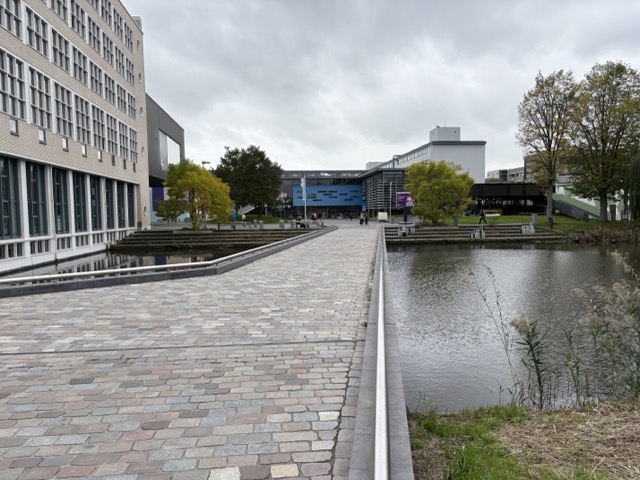
TU Delft campus by the water
On the TU Delft campus, home of the Faculty of EEMCS.
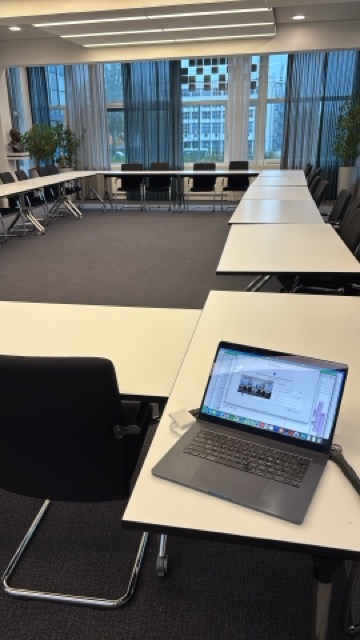
Seminar room at TU Delft before the talk
The seminar room, minutes before the talk.
Johannes Vermeer, View of Delft
Johannes Vermeer, View of Delft (c. 1660–1661), Mauritshuis, The Hague.

Joint publications with Rob Kooij

  • Social Contagion Drives Collective Consensus Formation on Scale-Free Networks
    Savari M, Horsevad N, Kooij RE, Chamanbaz M, Wernli D & Bouffanais R
    Scientific Reports (16), 2026. [pdf] [doi]
  • Controllability of a Class of Swarm Signaling Networks
    Sun P, Kooij RE & Bouffanais R
    J. Complex Networks (10):6, cnac054, 2022. [pdf] [doi]
  • Transition from Simple to Complex Contagion in Collective Decision-Making
    Horsevad N, Mateo D, Kooij RE, Barrat A & Bouffanais R
    Nature Communications (13), 1442, 2022. [pdf] [doi]
  • Tuning the Clustering Coefficient of Generalized Circulant Networks
    Kooij RE, Horsevad N & Bouffanais R
    Physica A: Statistical Mechanics and Its Applications (578), 126088, 2021. [pdf] [doi]
Three normalized digital surface models of West, Central and East London, with building heights shown in shades of blue

Our paper “The Complexity of Urban Verticality” has been accepted for publication in npj Complexity, the Nature Portfolio journal dedicated to complex systems. Kudos to lead author Benny Chin (Wei Chien Benny Chin, now at the Department of Geography, National University of Singapore), a former Research Fellow of the group, who carried this work from the first idea to the accepted manuscript. The paper is co-authored with Michael Lees (Informatics Institute and Institute for Advanced Study, University of Amsterdam).

As cities increasingly grow in three dimensions, their vertical structure has become an important yet under-examined component of urban form. The paper introduces a spatial scaling framework that characterizes urban vertical complexity directly from Digital Surface Model and Digital Terrain Model data. A hierarchical quadtree representation generates a Total Absolute Difference (TAD) profile across successive scale levels, and the slope of the profile’s tail serves as the principal metric for comparing places. The framework is tested on nested windows in Canary Wharf, on 192 one-kilometer windows across three London zones, and on 17 standardized urban-zone windows in England. Across these analyses the TAD profiles share a shallow head followed by a steeper tail, with most of the variation in the tail regime; the tail slope is related to the tallest buildings but is not reducible to height alone. The result is a quantitative way of comparing how vertical structure is organized across different urban landscapes.

The Complexity of Urban Verticality
Chin WCB, Lees MH & Bouffanais R
npj Complexity, accepted for publication, 2026. [pdf]

CED-2026, Economic Development & the Legacy of Simon Kuznets, Kharkiv, 29 October 2026

Roland Bouffanais has been invited as a keynote speaker at CED-2026, the annual International Scientific Conference “Economic Development and the Legacy of Simon Kuznets”, hosted on 29 October 2026 by Simon Kuznets Kharkiv National University of Economics (KhNEU) in Ukraine. This year the conference takes the form of a roundtable, “A Rebooting World: Sustainability, Innovation, and New Development Trajectories”, held both in Kharkiv and online. Roland joins a line-up of keynote speakers that includes Beata Javorcik (Chief Economist, EBRD), Howard J. Shatz (RAND), Volodymyr Ponomarenko (KhNEU) and Mark J. Brandt (Tilburg University).

His contribution will draw on our work in complexity science and computational diplomacy, and on how data-driven, AI-based approaches can support international cooperation and decision-making at a time of profound global change.

[conference website]

Our paper on simulating democratic deliberation with multi-agent large language models has been accepted at EMNLP 2026, the Conference on Empirical Methods in Natural Language Processing, to be held in Budapest on 24–29 October 2026. The work introduces VoteSim, a framework for representing pluralistic preferences through electoral systems in populations of LLM agents.

Simulating Democratic Deliberation: Representing Pluralistic Preferences through Electoral Systems in Multi-Agent LLMs
Faulkner R, Szufa S, Hoyer D, Zhang TJ, Bouffanais R, Leibo JZ & Jin Z
EMNLP 2026, Budapest, Hungary, October 2026. [pdf] [code]

Sankey diagram of the tactical structure learned for Atlético Madrid as the number of hidden states K grows from 3 to 7 (Rondeau, Barrat & Bouffanais, arXiv:2610.20095, Fig. 4)

Our Ph.D. student Arthur Rondeau has posted a new preprint on arXiv, together with Alain Barrat (Aix Marseille Université, CNRS, Centre de Physique Théorique). When all we observe is a system’s dynamics — for instance a sequence of visited nodes — how can we tell whether group (higher-order) interactions are really at play, or whether pairwise interactions suffice? Group interactions leave a trace as memory in the observed sequence, but a memory-driven pairwise process can mimic that same footprint. The paper introduces an inference pipeline built on a hidden Markov model whose latent states are the hyperedges of an unobserved hypergraph, turning the question into a falsifiable model-selection test against memoryless and memory-based pairwise baselines. Applied to ball-possession trajectories from professional football matches (StatsBomb open data), the recovered hyperedges map directly onto recognizable tactical team formations.

Uncovering Higher-Order Interactions from Memory in Observed Dynamics
Rondeau A, Barrat A & Bouffanais R
arXiv preprint arXiv:2610.20095 [cs.SI], October 2026. [pdf] [arXiv] [doi]

The doctoral work of our Ph.D. student Mohammad Savari on social contagion is out in Scientific Reports (Nature Portfolio). Most social networks are dominated by a few highly connected hubs, and the textbook view was that this structure stifles the kind of complex contagion needed to reach collective agreement. This study shows the opposite can be true: under the right conditions, scale-free networks support the spread of complex contagions and drive collective consensus.

Social Contagion Drives Collective Consensus Formation on Scale-Free Networks
Savari M, Horsevad N, Kooij RE, Chamanbaz M, Wernli D & Bouffanais R
Scientific Reports (16), 2026. [pdf] [doi]

Entrance of the Institute for Advanced Study (IAS), University of Amsterdam, Oude Turfmarkt

Roland Bouffanais joins the Institute for Advanced Study (IAS) of the University of Amsterdam as a Fellow for 2026–2027, to exchange perspectives with colleagues across complexity science, international relations and technology governance.

On 20 October 2026 he gives his fellowship lecture, “Computational Diplomacy: How Computation and Diplomacy Make Each Other”. The starting point is a two-way relationship: computation is changing how we study and practice diplomacy, while diplomacy increasingly shapes the development and governance of computation. When we describe AI development as a “race”, how does that description shape the choices that follow, and how do we study a system when our own models and narratives can influence its behavior? This line of inquiry is also one strand of the doctoral research of Chloé Marteil.

[event page]

Photo: Institute for Advanced Study, University of Amsterdam (ias.uva.nl).

First page of the IntLawNER arXiv preprint

Our new preprint introduces IntLawNER, a named entity recognition dataset and benchmark for international law.

IntLawNER: A Named Entity Recognition Dataset and Benchmark in International Law
Skura G, Bouffanais R & Wernli D, arXiv preprint arXiv:2609.22529 (2026).

[pdf] [doi] [web]

AI-driven crises could rapidly spread across finance, cybersecurity, shipping and other critical systems. Scenario exercises can help decision-makers prepare by testing existing responses, exposing gaps and building regional-to-global coordination. The Science in Diplomacy Lab (SiDLab) joined the team of experts behind this new policy report by Chatham House, AI Safety Asia and the University of Geneva.

Scaling AI Crisis Diplomacy: How to Use Scenario Exercises to Build Capacity and Readiness
Wilkinson I, Krasodomski A, Kelati A, Meceda A, Tsoi E, Bąk M, Lau WY, Bouffanais R, Radu R, Krishna S, Andresen A, Halpern A, Bobrovsky I, Avin SE & Wilkinson R
Chatham House Policy Report, London, September 2026. [pdf] [web]

Bouffanais’ Research Lab  ·  Applied Complexity Group  ·  Faculty of Science & Global Studies Institute, University of Geneva
Copyright © 2026 Roland Bouffanais | All Rights Reserved